
The West continues to impose restrictions against undesirable countries. Until recently, this bloc seemed to be monolithic, but tariff and other wars are progressing there at present – contributing to international tensions. What can be the result of such development of events?
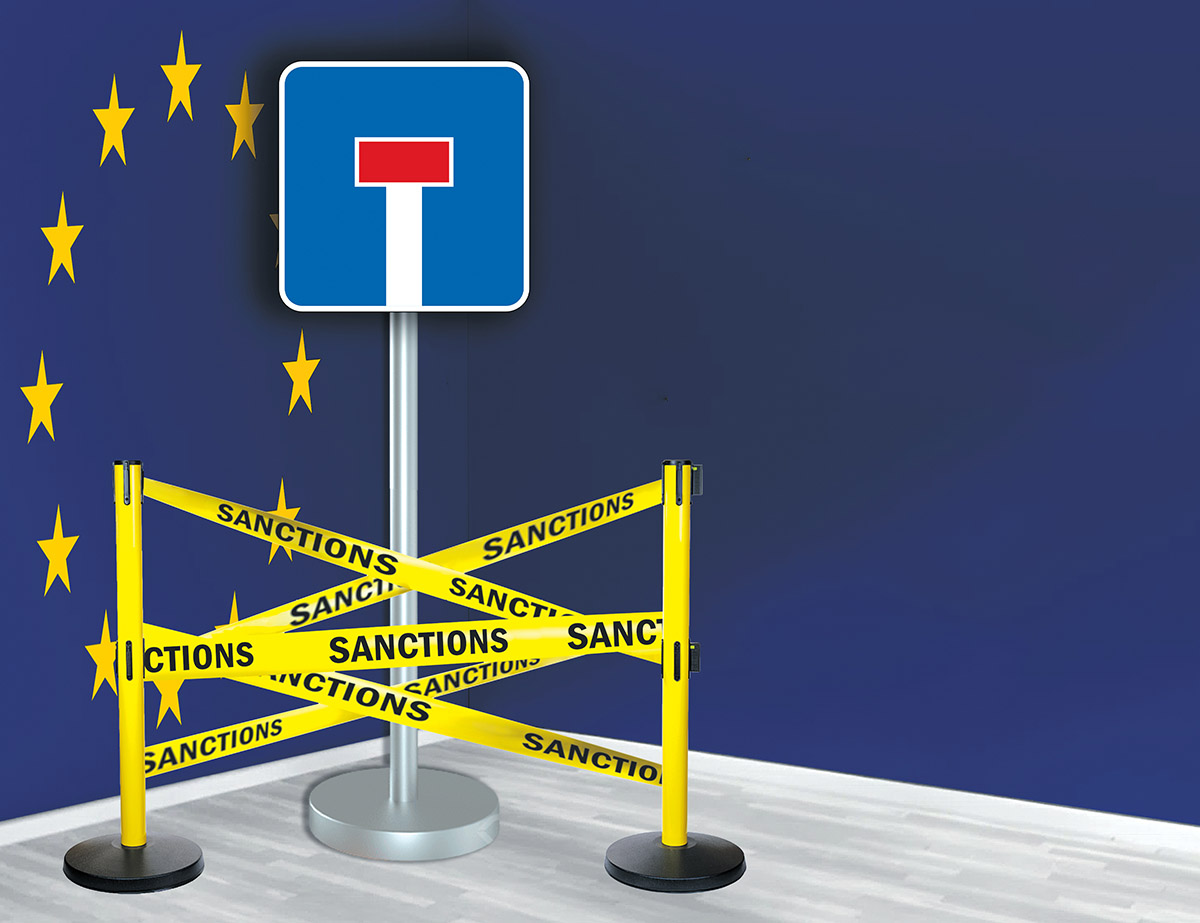
Mirage of values
Sanctions are usually perceived as a relatively new reality, but this is actually not the case: the West used them to fight against the Soviet Union through almost all the years of its existence, Belarus emerged as a significant power under external pressure and, after 2014, restrictions became part of everyday life in Russia as well. Differently speaking, sanctions are a long-standing and routine tool – primarily, with the economic focus: their use envisages a deliberate lowering of prices for goods from an undesirable country, which will be forced to sell them in a roundabout way and at a significant discount.
In the West, the sanctions toolkit has not decreased recently: on the contrary, it has expanded many times. For example, Washington's tariff war against most of the world, including the European allies, is essentially the imposition of sanctions. The latter just have different names and lack the usual ideological packaging. In this regard, Donald Trump has put traditional Western hypocrisy aside: he honestly admits that he is building America's greatness, including through the ability and opportunity to project its power to other regions of the world. All this not just reduces Europe's value rhetoric to nothing (it is already going to pieces), but actually leaves it no chance to save face.
Partners taken down a peg
Why has Donald Trump become so active in destroying Europe's position? Or even why has he started to use the same restrictive tools to virtually dismantle the global economic order?
The US President is quite sincerely trying to make the United States great again, as he understands it. If to look at how America views itself, it is ‘a city upon a hill’ designed to bring its light to the rest of the planet. This is a perfectly good metaphor: a hill has one peak, so the United States can have no other country that may be equal to it, which means no one can speak to it on equal terms. Other states are possible only as vassals, opponents, and so on.
The leader of the United States rather sharply reminds Western countries that they are vassals, and challenges those whom he considers opponents. Trump's formula is quite simple: any country's interaction with the United States and its controlled markets is possible if it unconditionally recognises Washington's central role, which means swearing in a vassal oath as part of a modern homage ceremony, and on conditions that the White House will determine.
Who is the primary target of the impact in this case? Naturally, these are allies, who previously considered themselves partners, but who have now been given their real place.
‘The king is being played by the entourage’, and this is exactly the reason why Donald Trump has so actively begun to ‘rebuild’ it. The roughness of this process is due, among other things, to the fact that intraspecific competition is always stronger than the interspecific one.
Strange mission
There is actually a serious economic reason for everything that is happening today. The European Union as a political entity took shape in 1992, immediately after the USSR collapse, and its role as an operator in terms of taking control and developing the resources remaining in the post-Soviet countries (for which deindustrialisation processes were promoted throughout the former USSR) was far from the last argument, by virtue of which it became a partner of the United States.
That mission was more or less successfully completed by the beginning of the military conflict in Ukraine, and it is already obvious that the former resource base will not return: hopes of inflicting a strategic defeat on Russia look empty and unrealisable, Ukraine has transformed into a hopelessly subsidised entity, and the EU will try to throw off responsibilities to support it as soon as possible after real peace is achieved.
On militarisation of Europe
The United States is freeing its hands to move in other important areas, and a stake on AI and control through algorithms makes former partners meaningless for Donald Trump and his main stakeholders, which are large IT corporations and figures such as Peter Thiel, Elon Musk, and Sam Altman. These are not partners, but passengers, and this is also the struggle of the new American digital deep state with the old one which was based on the dominance of banking capital.
The outcome of this struggle is not at all a foregone conclusion. If Trump loses the midterm elections in the United States this November, he may well turn out to be a ‘lame duck’ and even get impeached. In this case, both the old American deep state, which is currently on the defensive, and the EU leadership tied to it will rise up. Can Trump, if he is clearly losing, initiate a series of conflicts that will turn out to be so large-scale that they will become grounds for cancelling the US elections? Well, this is also a completely possible scenario, sadly.
Actually, no immediate changes in the sanctions policy are obvious in any scenario. As regards the current ruling elites of Europe, sanctions have become the basis of their legitimacy, and their cancellation will inevitably raise the question of why and on what basis they were imposed, causing significant damage to the EU economy.
The elites understand this well and are trying to take the situation to the next level by militarising Europe. Their loss — and subsequent change — will become likely only if Trump wins the midterm elections in the United States. On the other hand, the United States of the victorious Trump is also an extremely challengeable state of affairs for the world.
Most countries outside the collective West – which observe this struggle and understand that it is going on for leadership in maintaining Western dominance in the world – see the future differently and with a more just world order.
Therefore, speaking about defining own policy, it is necessary to honestly admit that tactics are possible and strategy is unlikely in the western direction today, so this state of affairs needs to be taken into consideration when determining own priorities.
REVIEW OF COMMITMENTS
The economic meaning of the EU existence for the United States has been exhausted, and Trump, as a businessman, simply fixes losses, ‘crossing out’ the US obligations to the European Union that seem excessive and unjustified in the new conditions.
CUDGEL IN COMPETITIVE STRUGGLE
The correct question with regard to all possible restrictions is not when the West will abandon them – since it will not do so, as sanctions are a convenient and routine political and economic cudgel in the competitive struggle – but probably why the United States and Europe began to use this tool so differently after Trump came to power.
Obviously, Washington's policy in this area significantly undermines the position of Brussels. Europe, acting by draconian methods, is used to talking about its moral leadership and rightness, claiming that this is a policy of meanings. It looks ridiculous in the confrontation with the White House, to put it mildly: both the abduction of the Venezuelan President and American ambitions for Greenland have revealed the extreme flexibility of Western ‘principles’. The European Union has completely forgotten what it was pathetically voicing from various rostrums until recently.
