
Localisation — over 80 percent: how ambulances are manufactured in Belarus
The domestic automotive industry continues to bolster the country’s social sector. The MAZ-Kupava Automobile Trailers and Bodies Plant has commenced fulfilment of a major contract for Belarus’ Healthcare Ministry: medical institutions are to receive 160 new specialised ambulance vehicles. Twenty-two vehicles have already been handed over to medics, with a further eighteen to be dispatched to the customer in the near future. Full completion of contractual obligations is scheduled by the end of the year. This will enable the renewal of ambulance fleets across the entire country. Our correspondent visited the manufacturing plant to discover how this vitally needed transport is produced and what makes it unique.
 Nikolai Malets, assembly fitter
The idea of creating a domestically produced ambulance had been in the air for a long time. Yet there had been no pressing need, as the country’s healthcare system relied heavily on vehicles from well-known foreign brands. Once sanctions were imposed on Belarus, co-operation with those companies became impossible. It was then that the Belarusian manufacturer of trailers and bodywork recalled its earlier plans and resolved to fill the vacated niche — especially since, as the saying goes, there was no need to reinvent the wheel.
 Vitaly Yakubov
“Minsk Automobile Plant JSC — Managing Company of Belavtomaz Holding had developed a vehicle with a gross weight of up to 3.5 tonnes: an all-metal van designed for various purposes. We saw the potential for further development and began offering the market various conversion models built on this chassis. One of those proposals concerned ambulance vehicles. We asked ourselves: why — given our large and highly developed engineering industry, our high level of competence, expertise, know-how, knowledge and experience — are we not manufacturing this vehicle ourselves? We approached the Industry Ministry and the Healthcare Ministry, received support from all sides and a carte blanche to proceed with the work,” recounts Vitaly Yakubov, General Director at MAZ-Kupava Automobile Trailers and Bodies Plant, describing the inception of the large-scale project.
Initially, production of 66 vehicles was planned, and a programme was approved for the supply of 22 vehicles per year. From 2022 onwards, deliveries of domestically produced Class B ambulances commenced. This was a direct answer to the Western sanctions. “We studied the Technical Regulations of the Customs Union governing ambulances in meticulous detail. The specialists of our design department worked through every nuance and developed the model. We built a prototype, gathered all the interested emergency medical station staff under the auspices of the Healthcare Ministry, and presented the vehicle to them. We took on board every comment, listened to their suggestions and then produced the refined vehicles that went into series production,” the General Director outlines the project’s stages.
The first batch of vehicles was dispatched to the regions, and the developers received feedback some time later.
Socially significant project
The result is an entirely Belarusian product created using domestically manufactured units and components. The medical compartment is equipped with three swivel seats featuring adjustable backrests and seat belts, a headrest-equipped seat with two armrests, and a seat belt at the head end of the stretcher, ergonomically positioned so as not to obstruct the movement of staff. Also provided is a 250kg load capacity trolley stretcher with detachable chair-style stretcher, height-adjustable, complete with a drip stand holder, a frontal movement limiter and a locking mechanism. The driver’s cabin provides seating for two passengers.
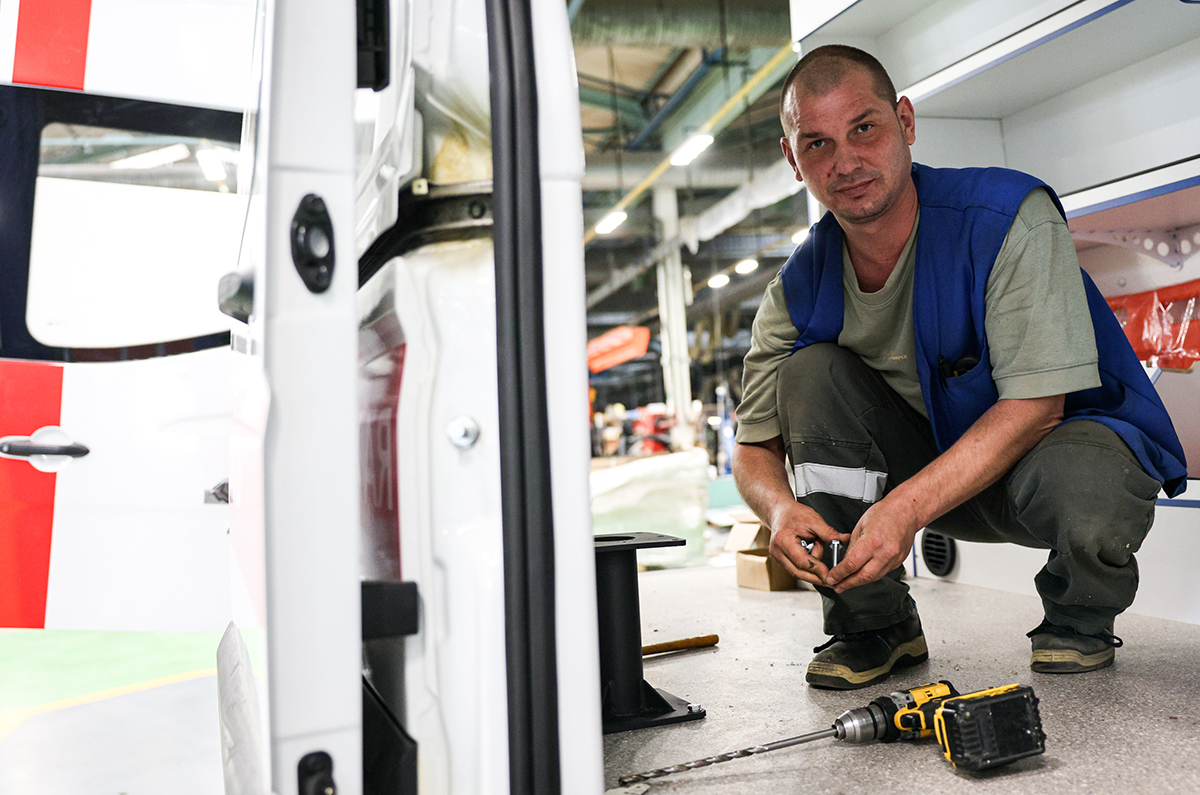 Andrei Parfimovich, assembly fitter
“The level of localisation in this vehicle exceeds 80 percent,” the General Director notes with evident pride. “All of the furniture, the oxygen system and the air conditioning are Belarusian. Furthermore, we use only domestically produced components. Certain items come from Russia. Co-operative ties are essential — why should we attempt to develop something in which our brothers, friends and partners are, for the time being, slightly ahead of us? We also recognise that we must work exclusively with trusted partners who will not let us down at the most critical moment. Our experience of dealing with the Europeans has taught us a great deal.”
When designing the vehicle, every wish expressed by medical service personnel regarding cabin ergonomics and the materials used was taken into account. The oxygen cylinder replacement system has been meticulously engineered, along with the autonomous heating arrangement and the stretcher securing mechanism, which allows for rapid and effortless removal and the performance of necessary procedures. In terms of electrical equipment and thermal regulation, the medical compartment is entirely self-sufficient — that is to say, its functioning does not depend on the engine running. This is achieved through an additional battery and the ability to connect an external power supply.
To date, the enterprise has manufactured over a thousand ambulance vehicles and has replaced virtually the entire fleet of such vehicles across the country.“This year we are to produce 160 vehicles, and in 2027 we shall assess the requirements of the Healthcare Ministry. For us, participating in such a large-scale and socially significant project — one that enhances the accessibility of emergency care — is both a great responsibility and a great honour. We understand that every vehicle we manufacture will work for the benefit of the people and for the reinforcement of trust in Belarusian industry. We are dependent on no one; we are capable of producing such sought-after products ourselves. Since Belarus is a socially oriented state, we do not even view this project from a commercial standpoint. Its profitability does not exceed five percent,” highlights Vitaly Yakubov.
Taking every wish into account
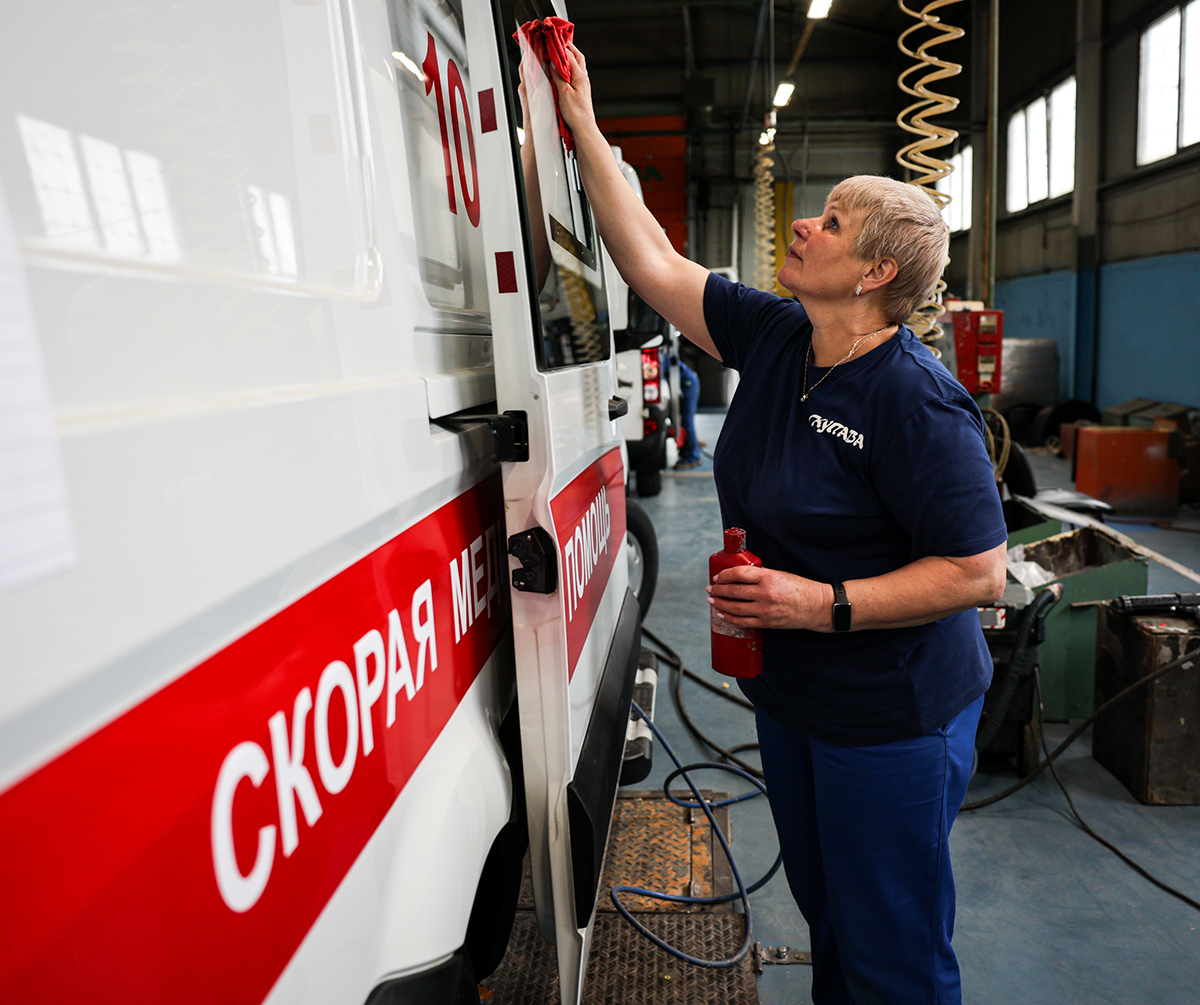 Valentina Milyachyonok, assembly fitter
The ambulances now being handed over to medical staff are already the fifth generation. Externally, no significant changes have occurred since the first model; all the innovations lie in the finer details. “For instance, on the first vehicles, the flashing beacons were mounted directly on the roof. However, complaints came in from drivers that some road users simply could not see them in operation and would fail to yield the right-of-way. We redesigned the model from an engineering standpoint, and as a result, the beacon lamp was positioned higher. There are quite a few such nuances. We listen to medical workers — after all, no one knows better than they do what is most convenient. The more comfortable they are in their work, the less fatigued they become, and the more people they can help,” asserts Vitaly Yakubov.
A curious fact: the very first ambulance produced at the enterprise was personally test-driven by the director alongside his colleagues. “We drove around — we even switched on the flashing beacon. We wanted to test the vehicle in full ‘combat’ readiness, not merely off the production line. Naturally, the vehicle had passed all certifications and trials, so we were confident it performed well. Anyway, I wanted to test it personally, to press the button activating the beacons, to experience that sense of pride in the product we had created. After all, without that feeling, why bother coming to work at all? A person should take pleasure in what they do,” concluded the General Director.
By Vladislav Sychevich
